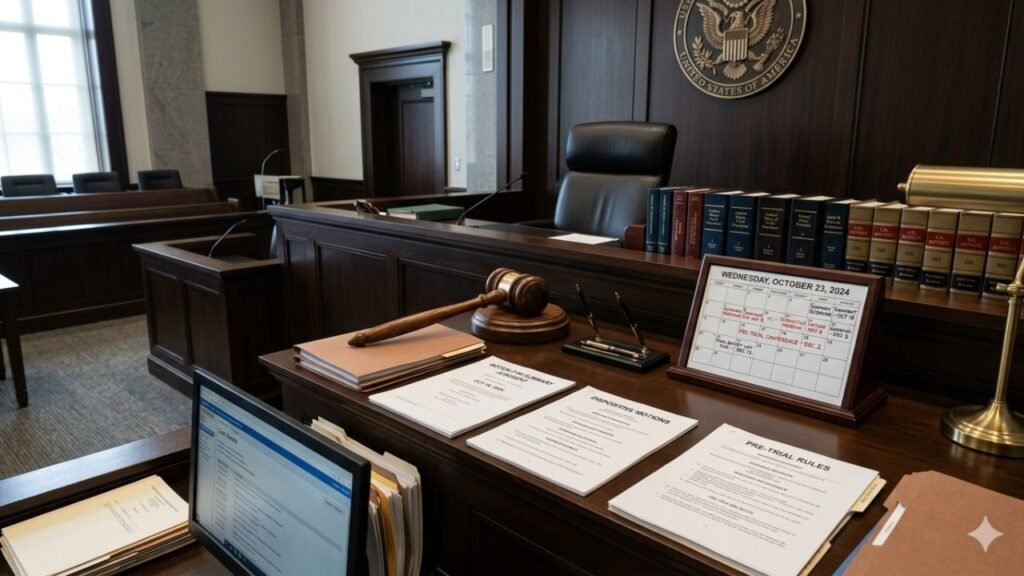
If you’re facing litigation in federal court, whether as an attorney, paralegal, or someone trying to understand the legal process, you’ve probably heard someone mention “motion deadlines” with a sense of urgency. And for good reason.
Thank you for reading this post, don't forget to subscribe!Motion deadlines in federal court aren’t just administrative checkboxes. They’re critical boundaries that can literally make or break your case. Miss a deadline, and your strongest argument might be locked out forever — including discovery cutoff dates, which are easy to miscalculate. File at the wrong time, and the judge might dismiss it without even reading your carefully crafted brief.
But here’s the thing: these deadlines don’t have to be a source of constant stress. Once you understand how motion deadlines work — and the FRCP rules behind them, especially when dealing with summary judgment and other dispositive motions, you can navigate the system with confidence.
In this guide, I’m walking you through everything you need to know about motion deadlines in federal court. We’ll break down summary judgment, explore dispositive motions, dig into pre-trial rules, and share practical tips to keep you on track. Let’s dive in.
Understanding Motion Deadlines in Federal Court
What Are Motion Deadlines, Really?
A motion deadline is essentially the final moment you can file a specific request with the court. Whether you’re asking the judge to dismiss the case, rule in your favor before trial, or compel the other side to produce documents, there’s a deadline attached.
Think of it like submitting homework. The teacher sets a due date. You can turn it in early. You can turn it in on time. But turn it in after the deadline, and it might not be accepted at all.
Federal courts are strict about this. Unlike some state courts that might give you a little wiggle room, federal judges take deadlines seriously. Really seriously. They see deadlines as a matter of professional responsibility and court administration.
The Federal Rules of Civil Procedure (FRCP) set the general framework, but here’s where it gets interesting: individual federal courts often have their own local rules that add additional requirements or change the timelines. Some judges have standing orders with even more specific requirements.
Why Motion Deadlines Matter So Much
Motion deadlines matter because they:
- Prevent endless litigation: Without firm deadlines, parties could file motions forever, dragging out cases indefinitely
- Protect the court’s schedule: Judges need to plan trial dates and manage their caseloads
- Ensure fairness: Both sides know when they can present arguments and when the window closes
- Create finality: At some point, a case needs to move forward to trial or settlement
Here’s something most people don’t realize: missing a motion deadline can be worse than losing on the merits. If you miss a deadline, you might not even get your arguments heard. The judge might reject your motion outright without considering the substance of what you’re arguing.
I’ve seen cases where an attorney missed a summary judgment deadline by two days just two days and couldn’t file the motion at all. The client’s strongest argument never made it to the judge.
Summary Judgment Motions Explained
How Summary Judgment Works (And When You Can File)
Summary judgment is one of the most powerful tools in federal litigation. It’s essentially asking the judge to rule in your favor without a trial because there’s no genuine dispute about the facts that matter.
To win summary judgment, you need to show that:
- There’s no genuine dispute of material fact
- You’re entitled to judgment as a matter of law
It sounds straightforward, but it’s incredibly complex in practice.
Here’s what happens: You file a motion for summary judgment. You attach evidence documents, affidavits, and deposition transcripts showing that your version of events is undisputed. The other side files a response arguing there ARE genuine disputes that only a jury can resolve. Then you get to file a reply, and eventually the judge decides.
Timeline and Deadline Considerations for Summary Judgment
This is where motion deadlines get critical. Under FRCP 56, you generally must file summary judgment motions at least 30 days before trial. But here’s the catch: local rules and standing orders often require filing much earlier.
Many federal judges want summary judgment motions filed:
- 60 days before trial in some districts
- 90 days before trial in others
- Even earlier, if the judge’s standing order says so
Why? Because judges need time to review the motions, request briefing, hold oral arguments, and issue decisions. They can’t do any of that if summary judgment hits their desk 30 days before the trial starts.
Some courts have a “summary judgment day,” usually several months before trial, when all summary judgment motions must be filed. Miss that date, and you might not be able to file at all.
Pro tip: Always check the judge’s standing order first. That document is your roadmap for motion deadlines in that judge’s courtroom. Ignore it at your peril.
Dispositive Motions in Federal Court
Types of Dispositive Motions and Their Deadlines
“Dispositive motion” is an umbrella term for any motion that could end the case (or a claim within the case) before trial. The main types include:
Motion to Dismiss (Rule 12(b)(6))
- Must be filed before or with your answer (usually within 21 days of being served)
- Challenges whether the plaintiff stated a valid legal claim
- If denied, you’ve preserved the argument, but the case moves forward
- Generally, the earliest motion deadline
Motion for Summary Judgment (Rule 56)
- Filed after some discovery has occurred
- Typically 60-90 days before trial, depending on local rules
- Can be filed by plaintiff or defendant
Motion for Judgment on the Pleadings (Rule 12(c))
- Can be filed after the pleadings close
- Less common than summary judgment
- Still subject to the same general timing rules
Motion to Enforce Settlement (Rule 68)
- Filed when you believe the parties have reached a settlement
- Timing varies based on when the settlement occurred
Each has different strategic implications and different deadline requirements. But the principle is the same: miss the deadline, and you lose your shot.
Common Pitfalls With Dispositive Motion Deadlines
The “Judge said nothing about it” mistake: You assume that if the judge hasn’t given a specific deadline, you can file whenever. Wrong. The local rules still apply, and ignorance of those rules won’t get you an extension.
Relying on the FRCP deadline alone: Federal Rule 56 says 30 days before trial. Your district’s local rules might say 60 days. File based on the FRCP deadline, and you’re late.
Submitting motions past the deadline with an “emergency” label: Just adding “EMERGENCY” to your motion doesn’t make it timely. Judges hate this. It looks like you’re trying to game the system.
Assuming email timestamp equals filing time: In federal court, the official filing time is when the document is accepted by the electronic filing system (CM/ECF), not when you hit send on the email attachment.
Pre-Trial Rules and Scheduling Orders
Understanding Local Rules That Affect Motion Deadlines
Every federal district has local rules. Some are reasonable and straightforward. Others seem designed to confuse. But they all matter.
Local rules often specify:
- The exact deadline for motions (sometimes as specific as “by 5:00 PM on a specific date”)
- Page limits for briefs (not just word counts, but actual pages)
- Font requirements (yes, judges care about this)
- Whether certain motions can be filed (some judges don’t allow summary judgment; some discourage motions in limine)
- How much notice do you need to give before filing
Different districts have wildly different requirements. The Middle District of Florida has different rules from the Northern District of Illinois, which has different rules from the Central District of California. If you’re working in multiple districts, you need to know each one’s rules.
The good news? Local rules are public. You can find them on the federal court’s website. No excuses.
Standing Orders: When Your Judge Makes Additional Rules
A standing order is a document issued by an individual judge that says, “Here’s how things work in my courtroom.” It often overrides what you might infer from the local rules or the FRCP.
A standing order might say:
- “All summary judgment motions must be filed by January 15 for April trials.”
- “Motions cannot exceed 20 pages, including attachments.”
- “I require a meet and confer letter before filing any motion.”
- “No motions will be accepted within 45 days of trial.”
Standing orders are how judges manage their workload and make their expectations clear. If a judge’s standing order says something, that’s the rule in that judge’s courtroom. Period.
Where do you find standing orders? Usually, on the judge’s page on the federal court website. Sometimes,s in the case management system, after you’re assigned to a judge. Always ask the court clerk if you can’t find it.
Practical Tips for Meeting Motion Deadlines
Tip #1: Create a Motion Deadline Calendar the Moment You’re Assigned a Judge
The day you’re assigned to a judge, do this:
- Find the judge’s standing order
- Find the local rules for your district
- Calculate every motion deadline based on the trial date
- Put those dates in a calendar with reminders
- Share the calendar with your team
This takes 30 minutes and prevents disaster. The cost of missing a deadline, losing your case, malpractice liability, and client dissatisfaction is infinitely higher than the 30 minutes of preparation.
Tip #2: File Early, Not at the Deadline
There’s a difference between filing by the deadline and filing early. Filing early gives you:
- A buffer for technical issues (filing system crashes, internet problems)
- Time to correct errors before the judge reads it
- Proof you weren’t rushing (less likely to have mistakes)
Courts are increasingly busy. An electronic filing system crash at 4:59 PM on the deadline is a disaster you don’t need. File days in advance whenever possible.
Tip #3: Verify Your Local Rules Quarterly
Court rules change. New standing orders are issued. Local rules get amended. What was true six months ago might be outdated now.
Every quarter, spend 20 minutes verifying that:
- The judge’s standing order hasn’t changed
- The local rules haven’t been amended
- There are no new administrative orders affecting motion practice
This is especially important if you don’t regularly practice in a particular federal court.
Tip #4: Always Include a “Meet and Confer” Statement
Before filing almost any motion (except motions to dismiss), the FRCP and many local rules require that you attempt to resolve the issue with the other side. This is called the meet and confer requirement.
Include a detailed statement in your motion explaining:
- When you tried to meet and confer
- What you discussed
- Why couldn’t you resolve the dispute
Judges pay attention to this. If you filed a motion without a good faith effort to confer with the other side, the judge might reject it or sanction you.
Tip #5: Use Technology to Your Advantage
Use:
- Calendar apps with notification reminders (set them for two weeks before and three days before each deadline)
- Practice management software that tracks filing deadlines
- Document templates so you’re not starting from scratch for routine motions
- Checklists for each type of motion
- Technology can’t replace understanding the rules, but it can ensure you never forget a deadline.
Frequently Asked Questions
What Happens If I Miss a Motion Deadline?
If you miss a deadline, your options are limited. You might file a motion for reconsideration under Rule 59(e), or ask the judge to extend the deadline under Rule 6(b). But neither is guaranteed.
Does Electronic Filing Change Deadline Rules?
Electronic filing (CM/ECF) makes meeting deadlines easier, but the rules don’t change. Your document must be uploaded before midnight of the deadline date. The court’s system might close earlier (often 11:59 PM), so plan accordingly.
Can I File the Same Motion Twice?
Generally, no. Once you file a motion, you’ve used your shot at that particular argument. If it’s denied, you can’t file the same motion again in the same case, even with different wording.
What’s the Difference Between a Motion Deadline and a Response Deadline?
A motion deadline is when YOU file. A response deadline is when the other side must respond. If you file a motion on Friday, the other side might have 14 days to respond (so it’s due Friday two weeks later).
Do Holiday Weekends Extend Motion Deadlines?
Yes, usually. Under FRCP 6(a), when a deadline falls on a weekend or federal holiday, it’s automatically extended to the next business day.
But don’t rely on this. Plan your filing schedule assuming the deadline lands on the date specified. If a holiday extends it, that’s a bonus, not something to count on.
Conclusion
Motion deadlines in federal court, whether for summary judgment, dispositive motions, or pre-trial scheduling, aren’t obstacles to overcome. They’re guardrails that protect the system and give both sides a fair chance.
The secret to managing them successfully is simple: preparation, attention to detail, and respect for the rules.
Start by understanding your specific judge’s expectations. Read the standing order. Know your local rules. Create a comprehensive motion deadline calendar. File early. Meet and confer in good faith. Double-check everything.
Yes, motion practice is complex. Yes, the rules feel overwhelming at first. But once you develop a system for tracking deadlines and understanding the requirements in each court, it becomes manageable, even predictable.
The attorneys who master motion deadlines aren’t necessarily the smartest legal minds. They’re the organized ones. They’re the ones who treat deadlines as non-negotiable. They’re the ones who set reminders, follow checklists, and verify rules regularly.
If you’re navigating federal court for the first time, don’t be intimidated by motion deadlines. Break them down. Understand what they mean. Plan. And remember: missing a deadline isn’t a strategic failure. It’s a professional one.