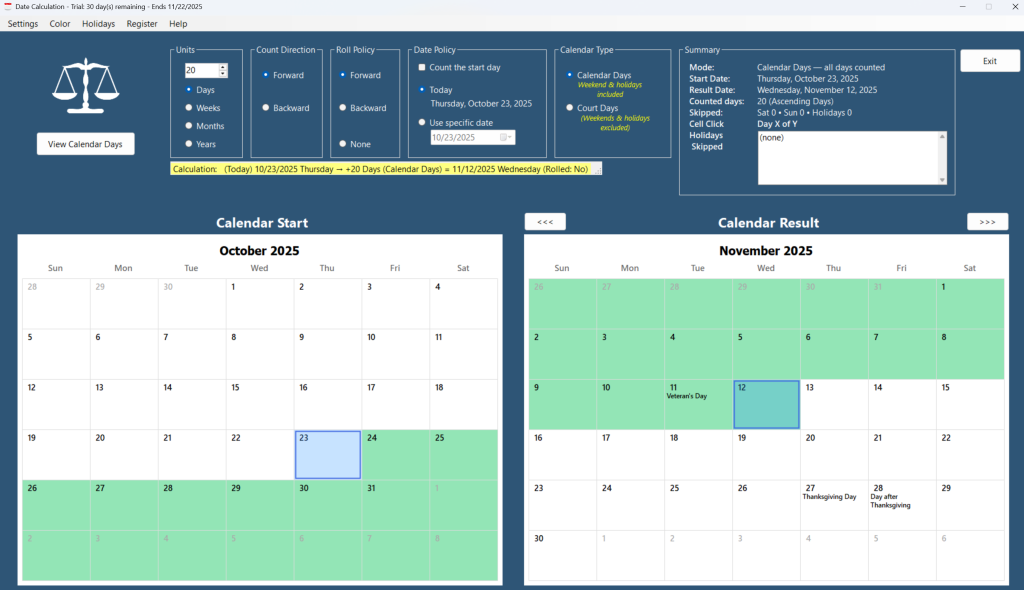
You’ve calculated the deadline three times. Twenty-one days from service, excluding weekends under Rule 6(a). You mark your calendar for Monday, January 19, 2026, confident the motion will be timely filed.
Then it hits you at 4:47 PM on Friday, January 16: Monday is Martin Luther King Jr. Day. Federal courts are closed. Your filing deadline just shifted to Tuesday, January 20 except now you’re scrambling to revise a brief you thought was finished, and opposing counsel has already filed their response early, making your arguments look reactive.
This scenario plays out in law firms across the country because the federal holiday calendar isn’t just a list of days off it’s a deadline calculation landmine that can derail even experienced litigators. Miss one federal holiday in your Rule 6 calculation, and you’re either filing unnecessarily early (burning time you needed for research) or risking sanctions for a late filing.
The federal court calendar for 2026 brings its own complications. Some holidays fall on weekends and get observed on different days. Some state courts follow different schedules. And if you’re practicing in multiple jurisdictions, you’re juggling federal holidays, state-specific holidays, and local court rules that may or may not align.
This guide breaks down everything you need to know about court holidays in 2026, how they affect deadline calculations under FRCP Rule 6, and the workflow strategies that keep experienced legal professionals ahead of the calendar.
What the Federal Holiday Calendar Actually Means for Your Practice
The federal holiday calendar isn’t just trivia, it’s a compliance requirement embedded in how you calculate every filing deadline in federal court.
Under FRCP Rule 6(a)(6), when the last day of a filing period falls on a holiday, the deadline extends to the next business day. This sounds straightforward until you’re dealing with holidays that shift based on weekends, state-specific observances, or local court rules that add extra closure dates.
Here’s what actually happens in practice:
When you’re served with a motion, you count forward to determine your response deadline. If you’re calculating a 21-day deadline under Rule 12(a)(1)(A), you exclude the day of service, count 21 calendar days, and if that final day lands on a weekend or federal holiday, the deadline moves to the next business day.
But here’s where it gets messy: you need to know which days are federal holidays before you start counting. If January 20, 2026 (Inauguration Day) is observed only in the D.C. area, does it extend your deadline in the Northern District of California? What about when New Year’s Day falls on a Sunday in 2023 and gets observed on Monday do you count Sunday as the holiday or Monday?
The federal court calendar operates on eleven designated holidays, established by 5 U.S.C. § 6103. These are the only holidays that automatically extend federal court deadlines nationwide:
- New Year’s Day (January 1)
- Martin Luther King Jr. Day (Third Monday in January)
- Presidents’ Day (Third Monday in February)
- Memorial Day (Last Monday in May)
- Juneteenth (June 19)
- Independence Day (July 4)
- Labor Day (First Monday in September)
- Columbus Day (Second Monday in October)
- Veterans Day (November 11)
- Thanksgiving Day (Fourth Thursday in November)
- Christmas Day (December 25)
Each of these holidays affects deadline calculations differently depending on when they fall during the week and whether they’re observed on a different day due to weekend placement.
Why This Matters: The Real Consequences of Holiday Miscalculation
Getting the federal holiday calendar wrong isn’t just an administrative error, it’s a malpractice exposure and a litigation strategy failure.
Missed Deadlines = Dismissed Claims
Federal courts enforce filing deadlines strictly. If your summary judgment response is due on what you thought was Monday, June 22, 2026, but you missed that June 19 (Juneteenth) fell on Friday and the courthouse was closed, your actual deadline might have been Thursday, June 18. Filing on June 22 could result in the court striking your response as untimely, potentially granting summary judgment against your client by default.
The consequences escalate in cases with jurisdictional deadlines. Appeals must be filed within 30 days under FRAP Rule 4(a)(1)(A). If you miscalculated because you didn’t account for Veterans Day falling on a Wednesday in 2026, you could blow the appellate deadline entirely and jurisdictional deadlines can’t be extended for mistake or excusable neglect.
Malpractice Claims Start Here
Legal malpractice insurers consistently identify missed deadlines as one of the top three sources of claims. A 2022 ABA study found that 11% of all malpractice claims involved calendar and deadline errors, with holiday miscalculations representing a significant subset.
When a client loses a case because their attorney miscalculated a deadline around a federal holiday, the malpractice claim writes itself: the attorney failed to exercise reasonable care in a fundamental aspect of practice management. These cases are particularly difficult to defend because the error is objective and easily provable.
Strategic Disadvantage
Beyond the malpractice risk, holiday miscalculations create strategic problems. If you’re planning to file a motion on the last possible day to maximize your research time, but you miscalculate the deadline, you might end up filing a day late—or worse, filing in a panic with a substandard brief.
Conversely, if you over-calculate and file too early because you’re worried about holiday confusion, you’re giving opposing counsel extra time to prepare their response. In fast-moving litigation, that extra day or two can shift the momentum.
State Court vs. Federal Court Confusion
Here’s where many attorneys trip up: state courts and federal courts don’t always observe the same holidays. If you practice in both state and federal court, you might have a case where the federal court is closed for Columbus Day (second Monday in October) but your state court is open. File in federal court on that Monday, and your filing doesn’t get stamped until Tuesday potentially missing your deadline.
California state courts, for example, observe César Chávez Day (March 31) as a holiday, but federal courts don’t. Massachusetts state courts close for Patriots’ Day (third Monday in April), but federal courts remain open. These state-specific holidays don’t extend federal court deadlines, but they do affect state court calculations and can create confusion when you’re juggling multiple dockets.
How to Calculate Deadlines Around Federal Holidays: Step-by-Step
Calculating court deadlines with the federal holiday calendar requires a systematic approach. Here’s the workflow that prevents errors:
Step 1: Identify Your Triggering Event
Start with the event that triggers your deadline service of a complaint, entry of an order, filing of a motion. This is Day Zero. Under Rule 6(a)(1)(A), you exclude this day from your count.
Example: You’re served with a motion for summary judgment on Friday, May 15, 2026. Day Zero = May 15. Your count begins on Saturday, May 16.
Step 2: Count the Full Period
Count forward the required number of days. For a 21-day deadline, count 21 calendar days from Day One (the day after service).
Continuing the example: Starting May 16, count 21 days forward. This brings you to June 5, 2026.
Step 3: Check for Weekend Interference
Under Rule 6(a)(1)(C), if your deadline falls on a Saturday, Sunday, or legal holiday, it extends to the next business day.
Continuing the example: June 5, 2026 is a Friday you’re clear on weekends.
Step 4: Check the Federal Holiday Calendar
This is the critical step. Cross-reference your calculated deadline against the federal court calendar for 2026. Check not just the date your deadline falls on, but the days immediately before and after.
Continuing the example: June 5, 2026 has no federal holiday interference. But if your deadline had fallen on June 19 (Juneteenth, a Friday), your filing would be due Thursday, June 18, or you could extend to Monday, June 22 if the court closure rule applies.
Step 5: Verify Local Rules
Always check your district’s local rules. Some districts have additional closure dates or modified rules for holiday observances.
The Central District of California, for instance, has historically closed on the day of the Rose Bowl when it falls on a weekday. The Southern District of New York sometimes closes for weather emergencies that aren’t federal holidays but still extend deadlines.
Step 6: Document Your Calculation
Create a written calculation memo for your file. Note the service date, the counting method, any holidays or weekends that extended the deadline, and your final due date. This documentation protects you if there’s later a dispute about timeliness.
Sample Calculation Memo:
Motion for Summary Judgment served: May 15, 2026
Response deadline: 21 days per Rule 56(c)
Day 0: May 15 (excluded)
Day 1-21: May 16 – June 5
Weekend check: June 5 = Friday (no extension needed)
Holiday check: No federal holidays between May 16 – June 5
Final deadline: June 5, 2026, by close of business
Calendar reminder set for: June 3, 2026 (2-day buffer)
Step 7: Set Multiple Reminders
Don’t rely on a single calendar entry. Set reminders at three points: one week before the deadline, two days before, and on the deadline day itself. This gives you escalating warnings if something slips through the cracks.
Real Legal Scenarios: How the 2026 Calendar Plays Out
Scenario 1: New Year’s Day Extension (January 1, 2026 – Thursday)
You’re calculating a 14-day deadline to file a notice of appeal. The judgment is entered on December 18, 2025. Counting forward 14 days brings you to January 1, 2026 New Year’s Day, which falls on a Thursday in 2026.
Under Rule 6(a)(1)(C), your deadline extends to the next business day: Friday, January 2, 2026.
The trap: Some attorneys assume New Year’s Day “moves” to Friday when it falls on Thursday, thinking Thursday becomes a regular business day. Wrong. Thursday, January 1 is the actual holiday. Courts are closed. Your deadline is Friday, January 2.
Practice tip: When a holiday falls on a Thursday, Friday remains a regular business day unless the court announces a special closure. Don’t assume a four-day weekend.
Scenario 2: Memorial Day Weekend Compression (May 25, 2026 – Monday)
You’re served with discovery requests on May 1, 2026. You have 30 days to respond under Rule 34(b)(2)(A). Counting forward 30 days brings you to May 31, 2026 (Sunday).
Under the weekend rule, your deadline extends to Monday, June 1, 2026.
But here’s what many attorneys miss: Memorial Day falls on May 25, 2026 (the last Monday in May). This doesn’t affect your June 1 deadline directly, but it does compress your working time. May 25 is a court holiday, meaning you effectively lose a business day in the final week before your response is due.
Practice tip: When a holiday falls in the week before your deadline, adjust your internal deadlines backward to account for the lost working day. If you normally plan to finish discovery responses by the Friday before a Monday deadline, Memorial Day weekend means you should target Thursday, May 21 as your internal completion date.
Scenario 3: Juneteenth Complication (June 19, 2026 – Friday)
You’re calculating a 21-day deadline for a reply brief. The opposition’s response was filed on May 29, 2026. Counting 21 days forward brings you to June 19, 2026 Juneteenth, which falls on a Friday.
Under Rule 6(a)(1)(C), your deadline extends to the next business day: Monday, June 22, 2026.
The complication: Juneteenth became a federal holiday in 2021, and some attorneys still don’t have it programmed into their deadline calculators. If you’re using an older legal calendar template or software that hasn’t been updated, it might not flag June 19 as a holiday, leading you to miscalculate.
Practice tip: Verify that your calendaring software includes Juneteenth as a federal holiday. If you’re using a manual system or Excel template, add it yourself. This is still a relatively new holiday, and not all systems auto-update.
Scenario 4: Veterans Day Mid-Week (November 11, 2026 – Wednesday)
You’re preparing to file a motion for summary judgment, and you want to maximize your research time. The deadline is November 11, 2026, which falls on a Wednesday Veterans Day.
Courts are closed. Your deadline extends to Thursday, November 12.
The strategic question: Do you file on Tuesday, November 10, or wait until Thursday, November 12? Filing on Tuesday gives the court an extra day to review before opposing counsel’s response is due. Filing on Thursday maximizes your prep time but risks technical filing issues (ECF outages, etc.) with no buffer.
Practice tip: When a deadline falls on a mid-week holiday, experienced litigators often split the difference: finish the brief by the Tuesday before the holiday, then use Wednesday to review for typos and substantive errors. File first thing Thursday morning if you need the extra day, but have the brief 95% done before the holiday arrives.
Common Mistakes That Even Experienced Attorneys Make
1: Treating Observed Holidays Like Calendar Holidays
When New Year’s Day falls on a Saturday, federal offices and courts observe the holiday on the preceding Friday. When it falls on a Sunday, they observe it on the following Monday.
The error: Attorneys sometimes treat the actual calendar date (Saturday, January 1) as a regular day because courts aren’t “officially closed” that day; they’re already closed for the weekend. This leads to miscalculations when deadlines fall on the Friday before or the Monday after.
The fix: For deadline calculation purposes, the observed date is what matters, not the calendar date. If New Year’s Day falls on Saturday, January 1, 2028, and courts observe the holiday on Friday, December 31, 2027, then Friday is the holiday for deadline purposes.
2: Ignoring Inauguration Day in the D.C. Circuit
Inauguration Day (January 20) is a federal holiday, but only in the Washington, D.C. area. If you’re practicing in D.C. federal courts or the D.C. Circuit Court of Appeals, January 20 is a court holiday when it coincides with a presidential inauguration (every four years).
The error: Attorneys practicing nationwide sometimes see “Inauguration Day” on a calendar and assume it’s a nationwide federal holiday like Memorial Day. It’s not. Outside D.C., January 20 is a regular business day.
The fix: If you’re calculating deadlines in D.C.-area courts and it’s an inauguration year (2025, 2029, etc.), treat January 20 as a holiday. For all other federal courts, ignore it.
3: Confusing State Holidays with Federal Holidays
State courts observe state-specific holidays that don’t apply in federal court. César Chávez Day, Patriots’ Day, Confederate Memorial Day (in some Southern states), and Casimir Pulaski Day (Illinois) are examples.
The error: Attorneys who practice primarily in state court carry over state holiday assumptions when calculating federal deadlines. They see “Patriots’ Day” on their Massachusetts calendar and assume federal court is closed. It’s not.
The fix: Maintain separate calendars for state and federal matters, or use color-coding in a unified calendar to distinguish federal holidays (affects federal deadlines only) from state holidays (affects state deadlines only).
4: Relying on Outdated Calendar Software
Many law firms use practice management software with built-in legal calendars. The problem: if the software isn’t regularly updated, it may not reflect recent changes to the federal holiday schedule.
Juneteenth became a federal holiday in June 2021. Software that hasn’t been updated since 2020 won’t include it. This creates a silent error: your deadline calculator thinks June 19 is a regular business day and calculates your deadline incorrectly.
The fix: Verify your software’s last update date. Cross-check critical deadlines against an authoritative source (federal court website, official OPM holiday schedule) rather than trusting your software blindly.
5: Not Accounting for Local Court Closures
Some federal district courts have local closure policies that go beyond the standard federal holiday calendar. Snow emergencies, natural disasters, or local events can trigger court closures that extend deadlines.
The error: You calculate a deadline based on the federal holiday calendar, but the court closes for a local emergency, and you don’t get notice in time to adjust.
The fix: Check your district court’s website the day before any major deadline. Many courts post closure notices on their homepage or via CM/ECF alerts. Sign up for emergency notification systems if your district offers them.
6: Filing Too Early Out of Fear
Ironically, being overly cautious about holidays can backfire. Some attorneys, worried about holiday confusion, file briefs 3-4 days before the actual deadline “just to be safe.”
The problem: You’re giving opposing counsel extra time to prepare their response, and you’re losing valuable research and drafting time that could strengthen your arguments.
The fix: Calculate the deadline accurately, then set your personal deadline 1-2 business days early as a buffer. This gives you safety margin without sacrificing strategic timing.
Pro Tips: How Experienced Legal Professionals Stay Ahead
1: Build a Multi-Year Holiday Reference Sheet
Don’t recalculate federal holidays every year. Create a master spreadsheet with federal holidays for 2026-2030, noting which day of the week each holiday falls on and any observation shifts.
Include columns for:
- Holiday name
- Actual date
- Day of week
- Observed date (if different)
- Notes (e.g., “D.C. only” for Inauguration Day)
Update this annually and share it with your entire legal team. When anyone needs to calculate a deadline, they reference the master sheet instead of Googling “is Columbus Day a federal holiday.”
2: Use Rule 6 Backward Calculation for Critical Deadlines
For high-stakes deadlines (appeals, summary judgment responses, dispositive motions), calculate backward from the deadline instead of forward from the triggering event.
Example: You know a summary judgment motion will likely be filed around May 1, 2026, and you’ll have 21 days to respond. Instead of waiting for service, calculate backward from potential deadline dates in late May. Check which dates would fall on holidays or weekends, and plan your research schedule around the worst-case scenario.
This “backward planning” approach prevents last-minute scrambles when a holiday you forgot about suddenly compresses your timeline.
3: Set Up ECF Alerts for Court Closures
Most federal courts send CM/ECF notices when the court will be closed for emergencies or special events. Make sure these alerts are enabled in your ECF notification preferences.
Go to PACER → Utilities → Notification Settings, and verify that “Court Closure Notices” are enabled. This gives you advance warning of unexpected closures that could affect your filing deadlines.
4: Maintain a “Holiday Conflict” Checklist
Keep a checklist of common holiday-related deadline conflicts:
- [ ] Deadline falls on actual holiday date
- [ ] Deadline falls on observed holiday (when actual date is weekend)
- [ ] Holiday falls during counting period (compresses working time)
- [ ] State holiday vs. federal holiday mismatch
- [ ] D.C.-specific Inauguration Day issue
- [ ] Local court closure beyond federal holidays
Run through this checklist for every deadline calculation. It takes 30 seconds and catches errors that can cost you cases.
5: Use Color-Coded Digital Calendars
Set up your Outlook, Google Calendar, or practice management calendar with color coding:
- Red: Federal holidays that close federal courts nationwide
- Blue: State holidays that close state courts in your jurisdiction
- Orange: D.C.-only holidays (if you practice in that circuit)
- Yellow: Local court closures or special events
This visual system makes it immediately obvious when a deadline might have holiday interference.
6: Build in Automatic Two-Day Buffers
For every external deadline (court filings, discovery responses), set your personal deadline two business days early. This buffer accounts for:
- Unexpected holidays you missed
- ECF technical problems
- Last-minute client edits
- Partner review delays
If you have a brief due Friday, your personal deadline is Wednesday. If you have a discovery due Monday, your personal deadline is Thursday. This habit alone eliminates 90% of deadline panic.
7: Reconcile Your Calendar Quarterly
Every three months, cross-check your upcoming deadlines against the official federal court calendar for your district. Pull the court’s annual calendar (most post them by December for the following year), and verify that your upcoming holidays match.
This quarterly audit catches software errors, missing updates, and local rule changes before they cause problems.
Frequently Asked Question
If a federal holiday falls on a Saturday or Sunday, which day is the observed holiday for deadline purposes?
When a holiday falls on a Saturday, federal courts observe it on the preceding Friday. When a holiday falls on a Sunday, courts observe it on the following Monday. For deadline calculation purposes, the observed day is what matters.
Does Juneteenth extend deadlines in all federal courts?
Yes. Juneteenth (June 19) became a federal holiday in 2021 under Public Law 117-17. All federal courts nationwide observe it, and it extends deadlines under FRCP Rule 6(a)(1)(C) just like any other federal holiday.
What happens if a court closes unexpectedly due to weather or emergency? Does my deadline extend?
Most federal courts have local rules addressing emergency closures. Generally, if the court issues an official closure notice (posted on the court’s website and/or sent via CM/ECF), any deadlines that would have fallen on that day extend to the next business day.
How do I handle deadlines that fall during the week between Christmas and New Year’s when both are federal holidays?
This situation occurs when Christmas falls on a Thursday or Friday, creating a holiday-dense week at year-end. For 2026, Christmas falls on Friday, December 25.
Calculate carefully: If your deadline calculation brings you to December 25, 2026 (Friday, Christmas Day), your deadline extends to Monday, December 28. December 26-27 is a regular weekend, not an extended holiday.
Conclusion
The federal holiday calendar for 2026 isn’t just a list of days off, it’s a critical compliance tool that affects every deadline you calculate in federal court. Understanding how holidays interact with FRCP Rule 6, knowing when holidays shift due to weekends, and distinguishing federal holidays from state-specific observances are core competencies for anyone managing a federal litigation calendar.
The difference between a timely filing and a missed deadline often comes down to a single holiday you didn’t account for. Build systems that catch these issues before they become problems: maintain an accurate holiday reference sheet, set multiple deadline reminders, cross-check your calculations against official court calendars, and build in buffers that give you margin for error.
Your malpractice insurer, your clients, and your professional reputation all depend on getting the calendar right. Master the 2026 federal court calendar now, and you’ll handle deadline calculations with confidence throughout the year.