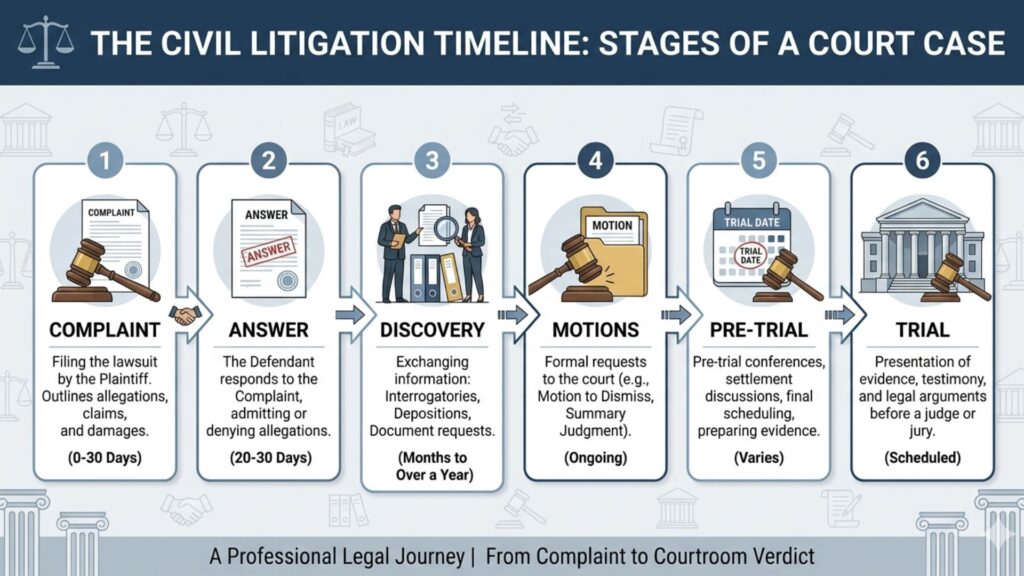
Every case that walks through your door comes with a clock already running. Filing deadlines, discovery cutoffs, expert disclosure windows, and pretrial conference dates miss one, and you’re not just explaining yourself to a judge. You’re explaining yourself to a client who trusted you with something that mattered.
Thank you for reading this post, don't forget to subscribe!A solid litigation timeline isn’t a luxury for large firms with dedicated docketing teams. It’s the foundation of competent case management, regardless of firm size. And yet, it’s one of the most inconsistently applied tools in litigation practice.
This guide walks through how to build one that actually works from before the complaint is ever filed to the week before trial.
Step 0: Start the Timeline Before the Complaint Is Filed
Most timelines begin the day the complaint is filed. That is already too late. Four of the most unforgiving deadlines in a case run before any scheduling order exists, and the first of them can kill the case before it ever reaches a courtroom:
1. The statute of limitations. This is the one deadline with no safety net. Miss it and the case ends before it begins — courts dismiss time-barred claims routinely, and equitable tolling is a narrow exception you should never plan around. Calendar the accrual date and the limitations deadline at intake, the day the client walks in, not the week you get around to filing.
2. Pre-suit notice and administrative prerequisites. Some claims cannot be filed until a separate process runs first. Employment discrimination claims generally require an EEOC charge within 180 or 300 days of the alleged violation; claims against government entities often require a tort-claim notice within 90 to 180 days. These are conditions precedent, not formalities. File the lawsuit first and handle them second, and you have filed a defective case.
3. The service clock. In federal court, Rule 4(m) gives you 90 days from the date the complaint is filed to serve the defendant — the filing day itself does not count, day one is the next day. Miss it and the court must either dismiss without prejudice or order service within a specified time, unless you show good cause for an extension. Our full breakdown of how long you have to serve a defendant after filing covers the state-by-state variations, which differ widely.
4. The defendant’s answer clock. Your timeline should include the opponent’s deadlines too, because they tell you when to expect the first responsive pleading, the first motion, and the Rule 26(f) conference that kicks off the scheduling process. In federal court, a defendant served with the summons and complaint has 21 days to answer under Rule 12(a)(1)(A); state courts typically give 20 to 30 days depending on the state and how service was made (see, for example, the Texas answer deadline).
Here is what a pre-filing triage looks like with real dates. A client walks in on January 20, 2026, with a federal claim carrying a two-year limitations period. The outside filing date is January 15, 2028. You file the complaint on Friday, January 10, 2028 — five days of cushion. Under Rule 4(m), the defendant must be served within 90 days of filing, which lands on April 9, 2028; because that is a Sunday, Rule 6(a)(3)(C) rolls the deadline to Monday, April 10, 2028. You serve the defendant on Wednesday, April 5. Under Rule 12(a)(1)(A), the answer is due 21 days later: Wednesday, April 26, 2028. Four dates, all derived from the incident date, all existing before any scheduling order is issued. That is why Step 0 comes first.
Add a pre-filing triage block to the top of every timeline template you build: limitations deadline, notice prerequisites, service deadline, anticipated answer date. Run the date math with the legal deadline calculator rather than counting on your fingers — a 90-day window that crosses a weekend is exactly where manual counting goes wrong.
Why Most Litigation Timelines Fall Apart Before Discovery Ends
The failure usually isn’t dramatic. It’s incremental. A deposition gets rescheduled. An expert’s availability pushes the disclosure date. Someone forgot to update the shared calendar. Then, six weeks before the discovery cutoff, you’re scrambling to depose witnesses you should have lined up months ago.
The problem isn’t the effort; most litigation teams work hard. The problem is that timelines get built once and treated as static documents. A litigation schedule is a living tool. It needs to be reviewed, updated, and stress-tested against real case developments, not just filed away after the Rule 16 scheduling conference.
Step 1: Anchor Everything to the Court’s Scheduling Order
The moment you receive the court’s scheduling order, that document becomes the backbone of your entire litigation schedule. Every internal deadline you set should trace back to a date or deadline within that order.
Pull out the key dates first:
- Discovery cutoff (fact and expert, if separate)
- Expert disclosure deadlines (plaintiff and defendant)
- Dispositive motion deadline
- Pretrial conference date
- Trial date
Work backward from the trial. That’s the only direction that forces discipline. A trial date set fourteen months out feels distant until you realize expert reports are due in five months, fact discovery closes in eight, and you haven’t issued a single subpoena yet.
In federal court, the scheduling order issued under Fed. R. Civ. P. 16(b) controls these dates. Modifications require a showing of good cause, and judges vary widely in how much flexibility they actually give. Never assume you can get an extension. Build your timeline assuming you can’t.
State courts operate differently. In Texas district courts, you’re often working under a docket control order that may compress or expand standard timelines depending on the judge’s standing orders. New York’s Commercial Division has its own preliminary conference order that sets an aggressive pace. California’s complex litigation departments run on their own scheduling programs entirely. Know your forum before you build your timeline.
Step 2: Layer in Your Internal Working Deadlines
Court deadlines are the floor, not the ceiling. Your internal case timeline template should add a second layer of working deadlines built in earlier to give your team actual preparation time.
A reasonable internal buffer framework:
Court Deadline Internal Working Deadline
Expert disclosure 3 weeks prior
Discovery cutoff 2 weeks prior
Dispositive motion filing 10 days prior
Pretrial filings (jury instructions, exhibit lists) 1 week prior
Deposition of key witnesses 30–45 days before cutoff
These aren’t arbitrary. They account for document review, attorney review cycles, client approvals, and the inevitable scheduling conflicts that appear in every case. Building the buffers in at the start means you’re not inventing urgency in the middle of a case; it’s already accounted for.
Step 3: Map the Discovery Phase With Granularity
Discovery is where most timelines go soft. It gets treated as a single block of time rather than a structured sequence of events, and that’s where cases fall behind.
A proper discovery deadline tracker breaks the phase into stages:
Early Discovery (Weeks 1–8)
- Serve initial disclosures under Rule 26(a)(1)
- Issue the first set of interrogatories and document requests
- Issue litigation holds to the client and third parties
- Begin document collection and review
Mid Discovery (Weeks 9–20)
- Review production from the opposing party
- Schedule and complete fact witness depositions
- Follow up on deficient responses
- Issue subpoenas to third-party custodians
Late Discovery (Weeks 21–Cutoff)
- Complete expert witness depositions (after disclosures)
- Resolve any outstanding discovery disputes
- Supplement disclosures as required under Rule 26(e)
- Confirm all depositions are transcribed and certified
In a complex commercial case, each of these stages may itself contain dozens of sub-tasks. In a single-plaintiff employment matter, the list is shorter, but the sequencing still matters. Doing depositions before reviewing document production is a common and avoidable mistake that costs attorneys credibility in the deposition room.
Step 4: Build the Motion Practice Timeline
Motions don’t live in isolation. A summary judgment motion filed at the deadline is a motion filed without adequate time for a reply brief if opposing counsel requests an extension. A Daubert challenge filed two weeks before trial is rarely going to get a full hearing.
Your motion practice timeline should account for:
- Meet and confer obligations before discovery motions (required in most jurisdictions)
- Brief preparation time realistic time, not theoretical time
- Reply brief windows under local rules
- Oral argument scheduling is typically set by the court
- Ruling timeline before trial: critical deadlines
In California state courts, motions to compel must typically be filed within 45 days of receiving deficient responses. In Texas, a summary judgment response is due 21 days before the hearing, not the filing date. These procedural nuances belong in your litigation timeline, not in your head.
Step 5: Plan the Trial Preparation Window
The trial preparation timeline is the section most teams build last and should build first. Everything you do in discovery, expert work, and motion practice is building toward what happens at trial. If you don’t know what you need at trial, you don’t know what to do in discovery.
At a minimum, your trial prep window should include deadlines for:
- Final exhibit list preparation and objections
- Jury instruction drafting and meet-and-confer
- Deposition designation and counter-designation
- Motion in limine filing and briefing
- Witness prep sessions (your witnesses and anticipated cross)
- Trial brief or trial memorandum
- Technology and courtroom logistics confirmation
Experienced trial litigators typically block the 30 days before trial exclusively for trial work. If you have a team, that window may be shorter. If you’re a smaller firm juggling multiple matters, you need to account for that reality in your timeline, not pretend you can prepare a two-week trial while actively managing four other files.
Common Timeline Mistakes That Create Malpractice Exposure
Relying on a single calendar system. If the court deadline lives only in one person’s calendar and that person is out sick the day of the deadline, you have a problem. Docketing redundancy is not paranoia; it’s professional responsibility.
Failing to calendar local rule deadlines alongside case deadlines. The case scheduling order sets the trial date. Local rules govern how many days before trial your pretrial filings are due. Both need to be in your system.
Not updating the timeline after scheduling changes. One rescheduled deposition can shift a chain of dependent deadlines. Every change to the case schedule should trigger a review of the timeline downstream.
Building discovery around your schedule, not the court’s. Many litigators front-load discovery with aggressive requests and then go quiet for months. By the time they circle back, the cutoff is close, and depositions haven’t been taken. Discovery should be paced, not bursty.
Litigation Timeline Best Practices for Case Managers
If you’re managing timelines across multiple cases, consistency matters more than sophistication. A simple spreadsheet used consistently beats an elaborate case management system that no one updates.
Establish a standard case timeline template for your firm or practice group, one that includes all the standard deadline categories and can be adapted to each case’s scheduling order. Review it weekly. Flag anything within 30 days. Escalate anything within 14 days.
For larger matters, consider assigning timeline ownership to a specific person on the team, separate from the attorney of record. A case manager whose explicit responsibility is calendar monitoring provides a meaningful check against the cognitive overload that comes with managing active litigation.
Frequently Asked Question
How far in advance should I build a litigation timeline?
Ideally, the day you receive the court’s scheduling order. Practically, within 48 hours of that date. Every day without a mapped timeline is a day where the team is operating without a shared understanding of where the case is going.
What should a case timeline template include?
At minimum: all court-ordered deadlines, internal buffer deadlines, discovery phase milestones, motion practice dates, and trial preparation benchmarks. Add jurisdiction-specific procedural deadlines as a second layer.
How do I handle a case where the scheduling order hasn’t been issued yet?
Build a preliminary timeline using anticipated dates based on your jurisdiction’s typical scheduling practices. Update it the moment the scheduling order issues. Never wait for the order before beginning to plan.
What’s the biggest risk of a poorly managed litigation timeline?
Beyond losing the case, the exposure is malpractice. Missed filing deadlines, blown discovery cutoffs, and late-filed motions can result in sanctions, adverse rulings, or dismissal any of which can become the basis for a legal malpractice claim.
Can I use software instead of a manual timeline?
Yes, tools like Clio, MyCase, and legal-specific project management platforms offer timeline and deadline tracking features. The tool matters less than the discipline of maintaining it. Software that’s not consistently updated is no better than a calendar no one checks.
When should a litigation timeline start — at intake or at filing?
At intake. The statute of limitations, pre-suit notice windows, and administrative filing deadlines all run before the complaint is filed. If you wait until filing to build the timeline, the earliest and least forgiving deadlines never make it into your system — which is how cases die before they start.
How long do I have to serve the defendant after filing in federal court?
Ninety days under Federal Rule of Civil Procedure 4(m), measured from the date the complaint is filed (the filing day itself is excluded; day one is the next day). If the deadline passes without service, the court must dismiss the action without prejudice or order service within a specified time, unless you show good cause for an extension. State courts set their own service windows, so never assume the federal rule applies in state court.
How long does a defendant have to answer after being served?
In federal court, 21 days after service of the summons and complaint under Rule 12(a)(1)(A) — longer if service was waived (60 days, or 90 if the defendant is outside any U.S. judicial district). State courts vary: most give 20 to 30 days, and the exact period depends on the state and the method of service. Put the answer deadline on your timeline even though it is the opponent’s obligation — it tells you when motion practice and the scheduling conference are coming.
What happens if I miss the statute of limitations?
The claim is barred. The defendant will move to dismiss, and courts grant those motions as a matter of course — a limitations defense is one of the few that can end a case on the pleadings. Equitable tolling and the discovery rule can save a claim in narrow circumstances, but they are fact-specific and litigated, not something to rely on when building a timeline.
Does the scheduling order override the other deadlines in my timeline?
It controls the post-filing sequence — discovery cutoff, dispositive motion deadline, pretrial filings, trial date — and changing it requires a showing of good cause under Rule 16(b). But it never overrides statutory or rule-based deadlines that exist independently of the order: limitations periods, pre-suit notice windows, the Rule 4(m) service clock, and answer deadlines all run on their own authority. Your timeline needs both layers, and you should never let a comfortable scheduling order make you forget the statutory layer underneath it.
Conclusion
A litigation timeline is not administrative work. It is substantive legal risk management. Every deadline in your case carries consequences procedural, strategic, or ethical. The firms that consistently deliver strong outcomes for clients aren’t necessarily the ones with the most resources.
They’re the ones who treat timeline management as a core professional competency, not a clerical function.Build it early. Update it often. And treat every deadline as if the case depends on it because eventually, one will.