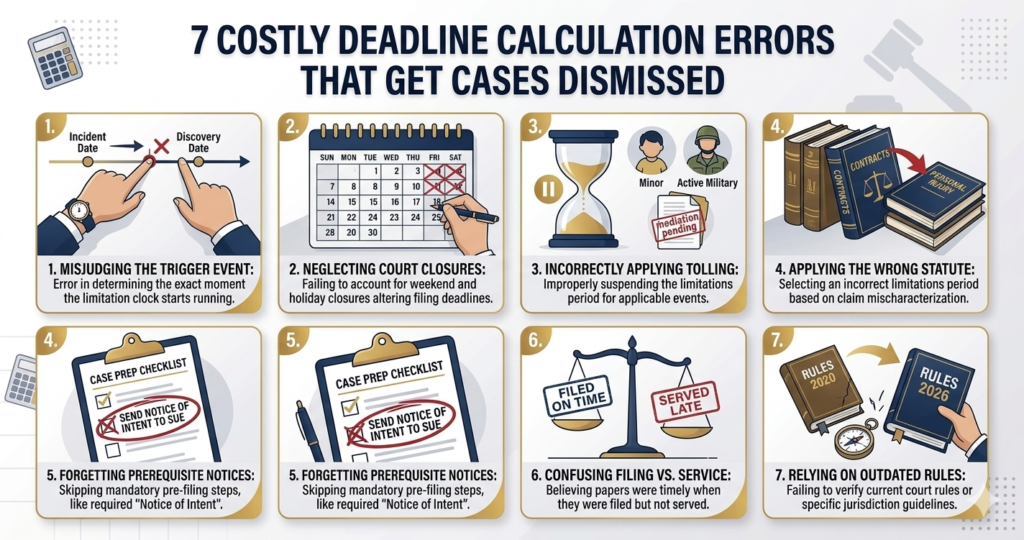
You know the feeling. You’re reviewing a dismissal order and realize the filing deadline passed three days before your paralegal docketed the complaint. Or you discover mid-deposition that your client’s statute of limitations expired because you didn’t account for the discovery rule. These aren’t minor oversights; they’re the kind of deadline calculation mistakes that end careers, trigger ethics complaints, and destroy client relationships.
Missed filing deadlines are among the top causes of legal malpractice claims. When a case gets dismissed for untimeliness, there’s no remedy, no appeal that saves you, and often no recovery for your client. The statute has run.
This guide walks through the seven most common and most expensive deadline calculation errors. Whether you’re a solo practitioner managing your own docket or a partner overseeing junior associates, understanding these pitfalls is essential to your practice. We’ll cover the mechanics of tolling, the traps of the discovery rule, state-specific notice requirements, and the docketing systems that actually prevent these disasters.
1. Ignoring Tolling Rules During Client Intake
The Error
You calculate the statute of limitations based on the injury date. You note it in the file. Then you miss that your client is a minor, your client is mentally incompetent, or the defendant was out of state when the clock started. The tolling rule that should have extended the deadline never gets flagged.
Why This Happens
Tolling provisions are scattered throughout state codes and aren’t always intuitive. A minor client’s statute of limitations doesn’t start running until they turn 18 (or reach the age of majority), but only in some jurisdictions and only under certain conditions. Some states toll the deadline if the defendant is absent from the state; others don’t. Fraud concealment tolls the clock in some courts but triggers an entirely different “discovery rule” in others.
During intake, you’re gathering facts, getting retainer signatures, and ordering medical records. Tolling analysis gets pushed to the back burner or delegated to a paralegal who doesn’t have the full context. The statute runs while everyone assumes someone else caught it.
How to Prevent It
During client intake, create a tolling checklist. Don’t estimate. Verify:
- Client’s age at the time of injury
- Client’s legal capacity (guardianship, conservatorship, competency)
- Defendant’s presence in the state when the cause of action arose
- Whether fraud, concealment, or misrepresentation delayed discovery
- Whether the client was married, in the military, imprisoned, or otherwise in a legal status that affects the timeline
In California, for example, a minor’s statute of limitations doesn’t begin until they turn 18—but this doesn’t apply if the minor’s parent was also injured by the same defendant. In Texas, an injured person’s statute of limitations can be extended if the defendant was not a resident of Texas and didn’t have authority to act as an agent for a resident when the cause of action accrued.
Document this analysis in your intake memo. Write it down. Date it. Don’t rely on institutional memory. If your paralegal finds out mid-discovery that you missed a tolling rule, the damage is already done.
2. Confusing the Discovery Rule with the Statute of Limitations
The Error
Your medical malpractice client was treated negligently in 2019. She didn’t discover the injury until 2022, three years later. You assume the statute of limitations runs from discovery, file your complaint in 2023 (within the typical three-year window), and feel confident.
Then the motion to dismiss arrives, citing your state’s statute of repose. Even though she discovered the injury recently, the statute of repose runs from the date of treatment, not discovery. Case dismissed.
Why This Happens
The discovery rule and the statute of repose are often confused, even by experienced practitioners. Here’s the distinction:
- Discovery Rule: The statute of limitations begins when the plaintiff discovers (or reasonably should have discovered) the injury or malpractice.
- Statute of Repose: An absolute deadline that runs from the date of the defendant’s act, regardless of when the plaintiff discovered the injury.
In many states, both apply simultaneously. The discovery rule extends your window, but the statute of repose sets a hard ceiling.
In California medical malpractice cases, the statute of limitations is three years from discovery, but the statute of repose is four years from the injury date, with a narrow exception for foreign objects left inside the body. File after four years, and your case is barred even if the plaintiff just discovered the injury.
In Texas, the statute of limitations is two years from discovery, but it can’t be extended beyond 10 years from the date the negligent act or omission was committed (the statute of repose), with exceptions for latent injuries not discoverable with reasonable diligence.
In New York, the statute of limitations is three years from discovery, but the absolute deadline is the earlier of (a) two years and 90 days from discovery or (b) four years from the date of the act or omission. The interplay is complex.
How to Prevent It
Research your jurisdiction’s discovery rule and statute of repose separately. Don’t assume they’re the same thing. Create a statute reference chart for your practice area and jurisdiction.
For medical malpractice claims specifically:
- Determine the date of the negligent act or omission.
- Determine the date of discovery (actual or constructive).
- Calculate both the discovery rule deadline and the statute of repose deadline.
- Use the earlier deadline as your red-line filing date.
- Docket both dates in your system so they’re visible to multiple people.
In malpractice defense, this is where depositions and expert reports become critical. When did the plaintiff first know something was wrong? When should she have known? The defense may argue that the injury was discoverable years earlier than the plaintiff claims, which would move the discovery date backward and potentially inside the statute of repose window.
3. Miscalculating the Running of the Clock: Days, Months, and Jurisdictional Rules
The Error
You count 180 days from the injury date. You come up with a deadline. You file on that day. Six months later, the defendant moves to dismiss the case as barred because you missed the actual deadline by 13 days.
The problem: You counted the running of the clock wrong.
Why This Happens
Different jurisdictions have different rules for how time is calculated:
- Does the clock start on day zero, or does it start on day one?
- If a deadline falls on a weekend or holiday, does it move to the next business day?
- Does “180 days” mean calendar days or business days?
- If the last day falls on a Saturday, do you file on Friday, or does Monday count?
Federal Rules of Civil Procedure Rule 6(a) provides that when a period of time is stated in days or a longer unit, if the period’s last day is a Saturday, Sunday, or a federal holiday, the period continues to run until the end of the next day that is not one of these days.
But state courts often have different rules. California’s Code of Civil Procedure Section 12a states that if the last day is a Saturday, Sunday, or other non-judicial day, the period extends to the next business day. But Texas’s rules are different: in Texas, the period includes Saturday and Sunday unless the deadline is a Saturday, Sunday, or legal holiday.
New York courts follow yet another calculation: time periods are calculated to include all calendar days unless otherwise specified.
These nuances matter. In medical malpractice cases with tight discovery rule deadlines, miscalculating by a single day can mean dismissal.
How to Prevent It
Never mentally calculate deadlines. Use a statute of limitations calculator tool specific to your jurisdiction, or rely on your legal calendar software (Timeslips, PCLaw, Clio, or your firm’s docketing system).
When you docket a deadline:
- Identify the triggering date (injury, discovery, filing of related action, etc.)
- Identify the time period in the statute (e.g., “within three years”)
- Consult your jurisdiction’s time calculation rules
- Enter the deadline into your docketing system, and let the software calculate it
- Create a second, earlier docket entry for a “red flag” date, typically 30 days before the deadline
In your firm’s docket procedures, build in redundancy:
- The filing attorney docks the deadline
- The paralegal double-checks the calculation
- The calendar system sends automated reminders 60 days, 30 days, and 14 days before the deadline
- A partner or senior associate reviews the calendar monthly
This seems excessive until you realize how many malpractice cases result from deadline failures. Redundancy is worth it.
4. Overlooking Jurisdictional Notice Requirements and Pre-Suit Deadlines
The Error
You’re representing a malpractice plaintiff and believe you have two years to file. But your state requires pre-suit notice to the defendant (or to a state agency) within 90 days of discovery. You missed the notice deadline. When you finally file, the defendant argues that the failure to provide notice bars the suit or requires dismissal.
Or you’re filing a federal FTCA (Federal Tort Claims Act) claim against the government. You assume you can file immediately, but the FTCA requires an administrative claim to be filed within two years of the accrual of the claim. You miss the administrative deadline and lose the entire claim.
Why This Happens
Many jurisdictions impose notice requirements before a suit can be filed. These are separate from the statute of limitations:
- Florida Medical Malpractice Notice Rule: Plaintiff must serve notice of intent to pursue a malpractice claim within four years of the act or omission, or within two years of discovery, whichever occurs first. If notice is given more than three years after the act, malpractice damages are capped.
- Texas Notice Requirement: A plaintiff must provide written notice within 120 days of filing suit or face sanctions or dismissal in some cases. But this is post-filing, not pre-filing.
- California Notice to Healthcare Providers: While not a statutory requirement in most cases, the discovery rule often requires that a certificate of merit accompany the complaint.
- Federal FTCA Claims: An administrative claim must be filed with the appropriate federal agency within two years of injury. Failure to do so bars the claim entirely.
- Veterans Malpractice (VA Claims): Special notice procedures apply to VA medical malpractice claims, and the FTCA’s two-year window applies.
- Public Hospital Claims: Some jurisdictions require notice to the hospital’s risk management or general counsel within specific timeframes before suit can proceed.
These notice deadlines are easy to overlook because they’re not the statute of limitations deadline. You may be well within the statute of limitations, but completely barred by missing the notice requirement.
How to Prevent It
During intake, research notice and pre-suit requirements for your specific claim type and jurisdiction.
Create a notice requirements checklist:
- Is notice to the defendant required? If so, when and to whom?
- Is notice to a state agency required? (Many medical malpractice regulatory boards require notice)
- Is there an administrative claim process that runs separately from the statute of limitations?
- Are there caps on damages if notice is late?
- Does the notice requirement change based on the defendant’s type (individual provider, hospital, government entity)?
For medical malpractice claims, include the certificate of merit (or affidavit of merit) deadline in your docket as well. In many states, the certificate must accompany the complaint or be filed within 90 days. If you miss this deadline, the complaint can be stricken.
Document notice in your file contemporaneously. Once notice is served (by certified mail, email, or personal service), note the exact date, method, and recipient. This becomes critical if the defendant later denies receiving notice.
5. Failing to Account for Continuous Treatment Doctrine (Medical Malpractice)
The Error
Your client received negligent treatment from Dr. A in 2018. She returned to the same practice for ongoing care through 2021. The last treatment date was May 2021. You file your complaint in July 2024.
You think you’re within the statute of limitations because the last treatment was only three years ago. But you miss that Dr. A’s negligence (the missed diagnosis) occurred in 2018, and your jurisdiction doesn’t recognize the continuous treatment doctrine. The statute of repose bars the claim.
Alternatively, your jurisdiction does recognize continuous treatment, but only if the negligent act and the continued treatment are related to the same condition. You failed to establish that relationship. The doctrine doesn’t apply.
Why This Happens
The continuous treatment doctrine (also called the “continuing treatment rule”) provides that when a healthcare provider’s negligent act is connected to a series of treatments for the same condition, the statute of limitations is measured from the date of the last treatment, not the date of the initial negligent act.
But this doctrine doesn’t exist in every jurisdiction, and its application is narrowly construed.
- California: Recognizes the continuous treatment doctrine for cases involving the same or related medical conditions.
- Texas: Does not broadly recognize continuous treatment; courts look at whether treatments were for the same condition and whether the plaintiff reasonably should have discovered the negligence.
- New York: Recognizes continuous treatment but applies it restrictively; the negligence and the subsequent treatment must be related to the same condition.
- Florida: Recognizes the doctrine but requires that the negligent act and the continuing treatment be part of the same course of treatment.
If you misread your jurisdiction’s application of continuous treatment, your statute of limitations calculation is off, and the case can be dismissed.
How to Prevent It
When a malpractice client presents with a long medical history, review the continuous treatment doctrine in your jurisdiction carefully.
Document:
- The date of the alleged negligent act
- The date of discovery (when did the plaintiff know something was wrong?)
- The dates of all subsequent treatments at the same facility or by the same provider
- Whether those subsequent treatments were related to the same condition or a different condition
If continuous treatment might apply, address it explicitly in your complaint or in a pre-suit legal memo. The court should see that you’ve considered the doctrine and analyzed whether your claim falls within its scope.
In depositions of the treating physician, establish the continuity of treatment. Did the provider continue treating the same condition? Were the later treatments related to the initial negligent act?
If continuous treatment is available in your jurisdiction, it extends your filing window significantly. Don’t leave it off the table. But don’t assume it applies if the facts don’t support it.
6. Miscounting the “Discovery” in Discovery Rule Cases
The Error
Your medical malpractice client noticed symptoms in January 2018. She attributed them to the original condition, not malpractice. In March 2022, she had a conversation with another physician who said, “That looks like a retained object from your surgery in 2017.”
When did she discover the malpractice?
You calculate from March 2022 (the conversation), file in March 2025, and believe you’re within the three-year discovery rule. But the defense argues discovery occurred earlier when she first noticed the symptoms because she had enough information to investigate further.
The court agrees with the defense. Case dismissed.
Why This Happens
The discovery rule doesn’t require actual knowledge; it requires knowledge sufficient to prompt a reasonable person to investigate. Different jurisdictions define this differently.
- Constructive Discovery: In many jurisdictions, the statute of limitations period begins when the plaintiff knew, or in the exercise of reasonable care should have known, of the injury and its cause.
- Diligent Inquiry Standard: Some courts hold that the statute begins when the plaintiff has facts that would prompt a reasonably diligent person to investigate.
- Medical Causation Requirement: Other courts hold that discovery doesn’t occur until the plaintiff knows or should know of the malpractice, not just the injury.
In a case where a patient develops chronic pain, the discovery rule is murky. Did she discover the negligence when she felt pain (likely too early), or when she was told the pain was caused by the doctor’s negligence (the actual malpractice)?
The difference between these standards can be the difference between a viable case and a dismissed one.
How to Prevent It
During intake, develop a detailed timeline of discovery.
Document:
- When did the plaintiff first notice an abnormal symptom?
- When did the plaintiff attribute the symptom to malpractice (not to the original condition)?
- What medical consultations or second opinions prompted that attribution?
- Did the plaintiff read online reviews or talk to other patients before suspecting malpractice?
- Is there evidence that a reasonably diligent person would have discovered the malpractice earlier?
If your jurisdiction uses a “constructive discovery” standard, assume the most conservative interpretation. If the plaintiff had discovered the malpractice earlier with reasonable diligence, the defense will argue that, and the court may agree.
Consult with a medical expert early to establish when the malpractice would have been discoverable by someone with medical knowledge. Use that timeline to calculate a conservative discovery date.
In depositions, be prepared for the defendant to argue an earlier discovery date. Document your client’s efforts to investigate, her reliance on the treating physician, and the specific facts that ultimately led to the discovery of malpractice.
7. Ignoring Wrongful Death Deadline Complications
The Error
Your original client (the injured plaintiff) passes away before the statute of limitations expires. You assume the cause of action survives to the wrongful death beneficiaries, and the clock keeps running.
But in your jurisdiction, the statute of limitations for wrongful death claims is different from the statute for personal injury claims. It’s shorter. It may run from the date of death, not the date of injury. It may not be subject to the tolling rules that applied to the original plaintiff.
You miss the wrongful death deadline and lose recovery for the beneficiaries.
Why This Happens
Wrongful death statutes are separate from personal injury statutes of limitations, and their language is often ambiguous.
- California: Wrongful death claims must be brought within two years of the plaintiff’s death, but the underlying injury must have occurred within the statute of limitations for the personal injury claim. The deadline is the earlier of these two.
- Texas: A wrongful death claim must be brought within two years of death. This is often shorter than the personal injury statute.
- New York: Wrongful death claims are subject to the three-year statute of limitations, but the cause of action doesn’t survive if the plaintiff dies before the statute expires. The decedent’s personal representative must bring the claim within three years of the death, not the injury.
- Florida: The statute of limitations for wrongful death is four years from death, but not more than five years from the date of injury.
These rules vary significantly, and if you misread the wrongful death statute, the case can be dismissed after the client’s death a particularly bitter failure.
Additionally, tolling rules that applied to the original plaintiff may not apply to wrongful death beneficiaries. A minor’s tolling may not extend the wrongful death deadline. Fraud concealment rules may apply differently. You can’t assume the tolling analysis from the personal injury claim carries over.
How to Prevent It
When a client dies during pending litigation or pre-litigation evaluation, immediately research your jurisdiction’s wrongful death statute.
Verify:
- What is the statute of limitations for wrongful death claims?
- When does it begin running (from death, from injury, from discovery)?
- Which tolling rules apply to wrongful death beneficiaries?
- Must the beneficiary be specifically identified in the original complaint, or can they be added later?
- Does the estate have to be probated before suit, or can a personal representative be appointed?
- Are there notice requirements specific to wrongful death claims?
File a wrongful death complaint (or amend the original complaint) well before any deadline expires. Don’t wait for the probate to be finalized if the statute of limitations is running.
Consider naming the decedent’s estate and “wrongful death beneficiaries to be identified” if you don’t yet know who the legal representatives will be. This preserves the claim while you sort out the succession issues.
Common Deadline Calculation Mistakes: Practical Examples by Jurisdiction
California
Medical Malpractice Statute of Limitations: Three years from discovery or one year from when the plaintiff should have discovered the injury through reasonable diligence, whichever is earlier. Absolute deadline (statute of repose): four years from the date of the negligent act, except for foreign objects.
Common Mistake: Assuming the continuous treatment doctrine always applies. California recognizes it, but only if the negligent act and subsequent treatment are related to the same condition. If the malpractice was in 2018 and the plaintiff received unrelated treatment in 2023, the continuous treatment doctrine doesn’t extend the deadline.
Risk: File the complaint on what you believe is day 1 of the four-year repose period, only to have the court rule that treatments after 2022 weren’t related to the original malpractice. Case dismissed.
Practical Workflow: During intake, have your physician expert review the entire medical record and opine whether later treatments were related to the negligent act. Document this in your file.
Texas
Wrongful Death Statute of Limitations: Two years from the date of death.
Medical Negligence Statute of Limitations: Two years from discovery but not more than 10 years from the date of the negligent act (statute of repose).
Common Mistake: Miscalculating the discovery date. Texas courts apply a strict constructive discovery standard: the statute begins when the plaintiff “knew of the injury and knew or should have known that the injury was caused by the defendant’s conduct.”
If a patient felt numbness in her leg after surgery but attributed it to normal post-surgical swelling, did she discover the malpractice then, or later when she was told the numbness was caused by the surgeon’s error?
Texas courts have ruled that a plaintiff has a duty of reasonable inquiry. If she noticed an unusual symptom and didn’t ask questions, the statute began running then, not when she eventually sought a second opinion.
Risk: File within what you believe is two years of the discovery date, only to have the court rule that your client should have discovered the injury earlier. Case dismissed.
Practical Workflow: Obtain detailed expert testimony on when the injury would have been discoverable by someone with reasonable medical knowledge. Use a conservative discovery date.
New York
Medical Malpractice Statute of Limitations: Three years from discovery, but no more than two years and 90 days from discovery (if discovery is constructive) or four years from the date of the act or omission, whichever is earlier.
Common Mistake: This is a three-layer calculation, and it’s easy to get wrong. You have to apply all three rules and use the earliest deadline:
- Three years from actual discovery
- Two years and 90 days from constructive discovery
- Four years from the act or omission
If the negligent act occurred on January 1, 2020, and the patient discovered the injury on December 1, 2023, the statute of limitations deadline is April 1, 2024 (four years from the act). You can’t file on January 1, 2027 (three years from discovery).
Risk: Miss the four-year deadline, thinking you have a three-year discovery window. Case dismissed.
Practical Workflow: Create a deadline calculation sheet for every malpractice client. Write down the date of the negligent act, the date of discovery (actual and constructive), and apply all three rules. Use the earliest deadline.
Florida
Medical Malpractice Notice Requirement: Notice of intent to pursue a malpractice claim must be served within four years of the act or omission, or within two years of discovery, whichever occurs first. If notice is served more than three years after the act, damages are limited to $250,000 (before 2023; check current caps).
Statute of Limitations: Four years from discovery or two years from when the injury was discovered or should have been discovered.
Common Mistake: Missing the notice deadline, which is separate from the statute of limitations filing deadline. A plaintiff might have two years to file suit after discovery, but she must give notice within four years of the act or two years of discovery.
Additionally, if notice is late (after three years from the act), damages are capped. Many attorneys miss this and promise clients full damages when only capped recovery is available.
Risk: Miss the notice deadline, and the case is barred, or damages are capped. Promise the client a full recovery and face a malpractice claim yourself.
Practical Workflow: At intake, immediately send notice of intent to pursue the claim if the case involves a healthcare provider. Docket both the notice deadline and the filing deadline. Include both in your statute of limitations memo.
Frequently Asked Question
What’s the difference between the statute of limitations and the statute of repose?
The statute of limitations measures the time from discovery (or injury, depending on the jurisdiction) to when suit must be filed. The statute of repose is an absolute deadline measured from the date of the defendant’s act or omission, regardless of when the plaintiff discovers the injury.
Can tolling rules extend the statute of limitations indefinitely?
No. Most jurisdictions cap tolling periods or apply statutes of repose that tolling can’t extend. A minor’s minority tolls the statute of limitations, but only until they reach the age of majority. Some states then give them an additional year to file after turning 18.
If your client is a minor and the statute of repose bars the claim before she turns 18, the statute of repose wins and the claim is barred regardless of the minority tolling rule.
If I file the complaint on the last day of the statute of limitations, am I safe?
Not necessarily. The complaint must be filed and served within the statute of limitations in most jurisdictions. Filing alone doesn’t satisfy the requirement; service must also occur timely.
Additionally, filing on the last day gives you no room for error. If there’s any question about whether the filing was timely (server delay, unclear filing date, etc.), the defendant will argue untimeliness. Leave yourself at least 30 days of buffer.
What if I discover the statute of limitations has expired after I’ve invested in the case?
You likely have a legal malpractice exposure. Your client has lost their claim entirely, and they have a claim against you for that loss.
Notify your malpractice insurance carrier immediately. Consider whether you can amend the complaint to relate back to an earlier filing date (Federal Rule of Civil Procedure 15(c) allows relation back in certain circumstances). Research whether there’s any equitable tolling doctrine in your jurisdiction that might apply.
Can I file a complaint that includes multiple counts with different deadlines?
Yes, but be careful. If some counts are barred by the statute of limitations, those counts must be dismissed, and you may be sanctioned for filing stale claims.
If you’re unsure about a particular count’s deadline, err on the side of including it. The court can dismiss stale claims on its own motion, and you can file an amended complaint if the situation clarifies. But it’s better to include a questionable count than to omit a viable one.
Conclusion
Missed filing deadlines rank in the top 5 causes of legal malpractice claims across all practice areas. When a deadline passes, there’s no remedy no appeal that saves the case, no legal theory that resurrects a stale claim. The statute has run, and your client has lost their entire claim.
The financial exposure is substantial. In medical malpractice cases, that lost claim might be worth millions. Your malpractice carrier will pay it, and your insurance premiums will spike.
But the reputational damage is worse. Your client will remember that you lost their case to a deadline failure. They’ll leave online reviews. They’ll tell other attorneys in town. Your practice will suffer.
Here’s what to do starting today:
- Review every active case in your docket. Verify that the statute of limitations deadline is correct.
- Audit your docketing procedures. Ensure you have redundant reminders, staff assignments, and verification steps in place.
- Create a statute of limitations checklist. Use it at the intake stage for every client.
- Document your deadline analysis in writing. Make it part of your case memo.
- Train your staff. Make sure every paralegal and junior attorney understands tolling rules, discovery rule nuances, and notice requirements in your jurisdiction.
- Review your malpractice insurance. Ensure your coverage limits are adequate given your practice area and case values.