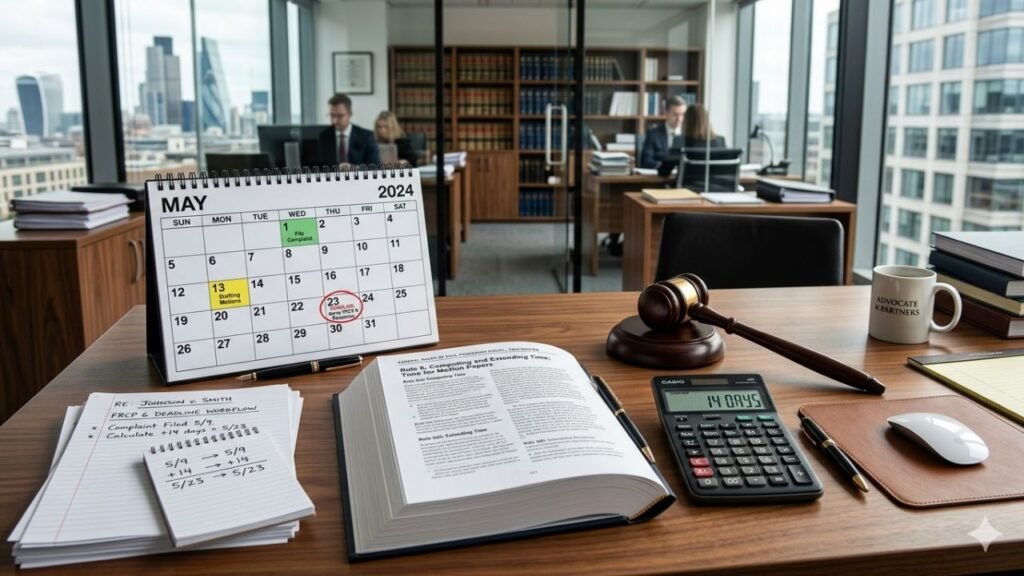
If you’ve ever been involved in a lawsuit or worked in a law firm, you know that deadlines aren’t just suggestions. They’re the backbone of the entire legal system. Miss one, and you might lose your case before it even gets to trial. This is where Federal Rules of Civil Procedure Rule 6 comes in.
Thank you for reading this post, don't forget to subscribe!Sound intimidating? It’s not. Once you understand how FRCP Rule 6 works, deadline calculation becomes straightforward. Whether you’re a lawyer, paralegal, or someone navigating a lawsuit, this guide will walk you through everything you need to know about calculating deadlines correctly.
Let’s be honest: the rules of civil procedure weren’t written to be exciting bedside reading. But they exist for a reason. They keep the legal system fair and predictable. And Rule 6? It’s the rule that tells you exactly how to count those days on the calendar.
What Exactly is FRCP Rule 6?
FRCP Rule 6 is all about time and how to calculate it in civil litigation. Specifically, it tells you:
- How to count days and hours when deadlines are involved
- When certain days don’t count (like weekends and holidays)
- What happens when a deadline falls on a day the courts are closed
- How to file documents before a deadline actually runs out
Think of it as the clock keeper of federal civil litigation. Without it, parties would be arguing forever about whether they made a deadline or not. Did you file at 11:59 p.m. on Friday, or was it Saturday? Does Saturday count? Rule 6 answers these questions.
The rule applies to all federal courts, and most state courts have similar rules. So understanding Federal Rule 6 gives you a solid foundation for understanding deadline rules almost anywhere.
Why Does Deadline Calculation Matter So Much?
Here’s the uncomfortable truth: courts don’t care about your excuses. If you miss a deadline under Rule 6, you’re late. Period.
Missing a deadline can result in:
- Your lawsuit is being dismissed
- Your evidence is being excluded from the trial
- Your response to a claim not being heard
- Significant fines or sanctions
- Losing your entire case by default
I’ve seen attorneys lose million-dollar cases because they miscalculated a deadline. Not because they didn’t have a good case, but because the paperwork didn’t arrive on time. It’s heartbreaking, which is why getting this right matters.
The good news? Deadline calculation under Rule 6 isn’t complicated once you know the rules. It’s actually quite mechanical. Follow the formula, count carefully, and you’ll be fine.
Understanding the Basics of FRCP Rule 6
Let’s break down the key concepts you need to know.
How Days Are Counted
When Rule 6 tells you that you have “10 days” to do something, it doesn’t mean 10 calendar days. The counting works like this:
You start counting on the day after the triggering event.
For example, if you’re served with a complaint on Monday, you don’t count Monday as day one. You start counting on Tuesday. That’s day one.
Then, if the deadline is 20 days, you count: Tuesday (1), Wednesday (2), Thursday (3)… and so on.
Which Days Don’t Count?
Here’s where it gets interesting. Not all days count toward your deadline.
Weekends and federal holidays don’t count if the deadline would otherwise fall on a weekend or holiday; you get until the next business day.
This is crucial. Let’s say you have a 7-day deadline, and day seven would fall on a Saturday. You actually have until the following Monday.
The holidays that don’t count are:
- New Year’s Day
- Martin Luther King Jr. Day
- Presidents’ Day
- Memorial Day
- Juneteenth National Independence Day
- Independence Day
- Labor Day
- Columbus Day
- Veterans Day
- Thanksgiving Day
- Christmas Day
If the deadline falls on any of these, you automatically get more time.
What About Hours?
When deadlines are measured in hours (which is less common but happens), the counting is different. You count all calendar hours, including nights and weekends. The deadline ends at the time specified, like 2 p.m. on a particular day.
Step-by-Step Guide to Calculating Deadlines Under Rule 6
Ready to actually calculate a deadline? Here’s how to do it.
Step 1: Identify the Triggering Event
First, figure out what event started the clock ticking. Common triggers include:
- Service of a complaint or motion
- Entry of an order by the judge
- Filing of a response or brief
- Delivery of notice
This is your starting point.
Step 2: Find the Deadline Number
Next, locate the deadline period. Is it 10 days? 20 days? 30 days? The deadline comes either from the rules themselves, the court’s order, or an agreement between the parties.
Step 3: Count the Days
Start counting from the day after the triggering event. Count each calendar day, but skip weekends and holidays.
For example:
- Triggering event: Friday, March 1st
- Deadline: 10 days
- Your count: Monday, March 4th (day 1), Tuesday, March 5th (day 2)…
- You count through Friday, March 13th (day 10)
- Your deadline is March 13th
Step 4: Check if the Deadline Falls on a Weekend or Holiday
If your calculated deadline lands on a weekend or federal holiday, you automatically get until the next business day.
Step 5: Add a Safety Buffer
Technically, you could file right up until the end of business that day. But here’s my professional advice: never cut it that close. File at least a day or two early. Technology fails. Offices get backed up. Traffic happens.
Common Pitfalls and How to Avoid Them
After years in litigation, I’ve seen the same mistakes happen repeatedly. Let me help you avoid them.
Mistake #1: Counting the Day of Service as Day One
This is the most common error. If you’re served on Monday, Monday is not day one. Tuesday is day one. I promise this is correct, even though it feels counterintuitive.
Mistake #2: Forgetting About Holidays
December is the worst month. Multiple holidays in a row. If your deadline calculation takes you through Christmas or New Year’s, you need to account for those days not counting.
Mistake #3: Assuming Electronic Filing Counts as “Midnight”
If you file something electronically, there’s a specific cutoff time, usually the court clerk’s deadline for that day, not midnight. Check your specific court’s rules.
Mistake #4: Not Accounting for the “Next Business Day” Rule
If your 10-day deadline ends on Friday at 5 p.m., and the court is closed on Friday (rare but possible), you actually have until Monday. Make sure you understand what days your specific court is open.
Mistake #5: Mixing Up Parties’ Agreements with Court Orders
Sometimes parties agree to extend a deadline. That’s fine, but it has to be in writing. Verbal agreements about deadline extensions don’t count. Get it in writing every time.
Real-Life Examples: Deadline Calculation in Action
Nothing beats seeing this in practice. Let me walk you through some actual scenarios.
Example 1: The Standard 20-Day Response
Sarah gets served with a complaint on Tuesday, January 15th. She has 20 days to file a response.
- Triggering event: Tuesday, January 15th
- Count starts: Wednesday, January 16th (day 1)
- Count through: Tuesday, February 4th (day 20)
- Deadline: Tuesday, February 4th
Sarah needs to file her response by the end of business on February 4th. If she’s smart, she files it on February 3rd, just to be safe.
Example 2: The Holiday Trap
Marcus receives a motion on Friday, December 19th. The response deadline is 14 days.
- Triggering event: Friday, December 19th
- Count starts: Monday, December 22nd (day 1)
- But Christmas (December 25th) doesn’t count
- And New Year’s (January 1st) doesn’t count
- Count through: Friday, January 9th (day 14)
- Deadline: Friday, January 9th
Notice how the holidays didn’t get a separate day—they’re just skipped entirely. Marcus needs to be careful with his count here, or he’ll think his deadline is earlier than it actually is.
Example 3: The Weekend Extension
Jennifer files a motion on Thursday, March 14th. Responses are due in 7 days.
- Triggering event: Thursday, March 14th
- Count starts: Friday, March 15th (day 1)
- Day 7 falls on: Thursday, March 21st
- This is not a weekend, so the deadline is Thursday, March 21st
Simple enough. But what if it were different?
- Same scenario, but Jennifer files on Thursday, March 14th, and responses are due in 5 days
- Day 5 would be: Tuesday, March 19th
- Tuesday isn’t a weekend, so the deadline is Tuesday, March 19th
But if responses were due in 7 days:
- Day 7 would be: Thursday, March 21st
- Thursday isn’t a weekend, so still Thursday, March 21st
Now, what if the deadline falls on a weekend?
- Jennifer files on Thursday, March 21st, with a 7-day deadline
- Day 7 would be: Thursday, March 28th
- Still a weekday, so the deadline is March 28th
But if the deadline were 8 days:
- Day 8 would be: Friday, March 29th
- Still a weekday, so the deadline is March 29th
And if the deadline were 9 days:
- Day 9 would be: Saturday, March 30th
- Saturday is a weekend, so the deadline extends to Monday, April 1st
Practical Tips for Staying on Top of Deadlines
Beyond just calculating, here’s how to make sure you never miss a deadline.
Use a Deadline Calendar
Don’t rely on memory. Create a physical or digital calendar specifically for legal deadlines. Mark them clearly. Use color coding if possible.
Set Reminders
Set reminders for at least two weeks before the deadline, and again one week before. When you get that reminder, actually do something about it.
Account for Court Closures
Call your court clerk or check the court’s website for any unusual closures. Some courthouses close early on certain days.
Create a Deadline Calculation Worksheet
Write out your calculation step-by-step. Show your work. This way, if someone questions it later, you have documentation.
Double-Check With a Second Person
If it’s an important deadline, have someone else verify your calculation. Fresh eyes catch mistakes.
Know Your Court’s Rules
Federal courts have similar rules, but each district can have local rules that affect deadlines. Read your court’s local rules carefully.
Frequently Asked Questions
What if I file one day late? Can I get it excused?
Technically, no. However, you can file a motion asking the court to excuse the late filing. This requires showing that you had good cause and that the delay won’t prejudice the other party. Courts are not sympathetic here, so prevention is definitely better than cure.
Do state court deadlines work the same way?
Most states have similar rules, but they’re not identical. Always check your specific state’s rules of civil procedure if you’re in state court.
What if the deadline is “before 5 p.m. on Friday” and I file at 4:59 p.m.?
You made it. Courts typically recognize the time-stamped on the electronic filing system, not your actual send time. Make sure you know your court’s rules on this.
Can parties agree to change a deadline?
Yes, but the agreement must be in writing unless the judge approves a verbal extension in court. Get everything in writing.
If I’m responding to a motion filed “on” a certain day, when does the clock start?
The clock starts the day after the motion is filed. So if a motion is filed on Monday, your time to respond starts counting from Tuesday.
Conclusion
FRCP Rule 6 deadline calculation might seem like a technical detail, but it’s absolutely critical to your success in federal litigation. I’ve seen too many good cases get derailed because someone miscounted days or forgot about a holiday.
The bottom line? Know the rules, count carefully, and always build in a safety buffer.
Remember:
- Count from the day after the triggering event
- Skip weekends and federal holidays
- If the deadline falls on a weekend or holiday, extend it to the next business day
- Document your calculations
- Set reminders
- Never cut deadlines close
You’ve got this. And now that you understand Rule 6, you can navigate federal litigation with confidence. The rules exist to make the system fair and predictable, and that benefits everyone, including you.
If you’re dealing with a lawsuit or considering litigation, don’t wing it on deadlines. Take the time to get them right. Your case depends on it.